FISMA Compliance: A Practical Guide

Federal agencies and institutions now face an unrelenting spotlight: over 1.5 million incoming Freedom of Information Act (FOIA) requests in 2024, representing a 25% increase from the previous year, reflect mounting pressure to deliver timely, defensible access to electronic records.
Meeting this demand, ranging from simple emails to complex data sets, without compromising sensitive information or classified data requires an information security posture that is both transparent and ironclad. Against this backdrop, the Federal Information Security Modernization Act (FISMA) remains the primary yardstick for evaluating cybersecurity readiness.
This guide equips IT leaders with a clear understanding of FISMA’s requirements, highlights recent regulatory shifts, and outlines best-practice strategies for achieving and sustaining compliance, specifically with regard to how modern email archiving platforms can ease compliance efforts, streamline audits and legal holds, and support FOI obligations.
Understanding FISMA: Purpose, Scope, and Recent Updates
FISMA is an evolving framework. Originally enacted in 2002 and modernized in 2014, FISMA regulation continues to adapt through executive orders and updates from the National Institute of Standards and Technology (NIST). Recent changes emphasize supply-chain risk, zero-trust architectures, and enhanced privacy and security controls.
Its scope now encompasses federal agencies, contractors, state programs managing federal funds, and universities conducting federally sponsored research. Even subcontractors handling federal information or federal information systems must align with FISMA controls to remain eligible for grants and contracts.
For IT and compliance leaders, the mandate is clear: understanding current FISMA compliance requirements — and how they translate into practical security controls, monitoring, and reporting — is essential for maintaining a resilient, continuously compliant information security posture.
Key Regulatory Updates and NIST Guidance
As of 2025, FISMA compliance aligns with the continuously updated NIST SP 800-53 security controls, which define safeguards by impact level and system type. Federal agencies are expected to integrate these updates into the Risk Management Framework (RMF) on an ongoing basis, maintaining up-to-date plans and real-time monitoring.
Viewing FISMA as a living program rather than a static checklist highlights the importance of email archiving solutions that preserve data integrity, support audits, and streamline reporting for organizational operations.
Core Requirements for FISMA Compliance
Before any technology investment or policy update can deliver value, agencies must demonstrate mastery of FISMA’s foundational obligations. The law prescribes a repeatable, evidence-based process that governs every federal information system.
Below is a concise checklist of these mandated activities:
- Maintain a comprehensive inventory of information systems, clearly documenting boundaries and data flows.
- Categorize each system by potential impact level — low, moderate, or high — using FIPS 199 criteria.
- Develop and maintain a System Security Plan that outlines controls, responsibilities, and residual risks.
- Implement the baseline security controls defined in NIST SP 800-53, tailoring them to the system’s impact level.
- Conduct formal risk assessments that evaluate threats, vulnerabilities, and the effectiveness of existing safeguards.
- Obtain Authorization to Operate (ATO) after an independent security control assessment.
- Establish continuous monitoring to validate controls, detect anomalies, and feed updates into the risk-management life cycle.
While these security requirements establish a defensible baseline, sustained compliance hinges on how effectively organizations translate the rules into daily operations.
Why Categorization and Baselines Matter
FIPS 199 assigns systems an impact level by gauging the consequences of a breach on confidentiality, integrity, and availability. Once that level is set, FIPS 200 maps the organization’s security objectives back to the appropriate NIST SP 800-53 baseline, ensuring control selection aligns with real-world risk.
Maintaining this traceability is critical, as failing to link objectives, impact, and safeguards can leave high-value assets underprotected.
A well-documented categorization process not only satisfies auditors, but also streamlines procurement and project planning by clarifying which protections are non-negotiable and which can be deferred or automated.
Continuous Monitoring and Risk Management
A single point-in-time assessment offers little comfort in a threat landscape that changes daily. Federal agencies are therefore required to couple annual security reviews with automated monitoring tools that track control effectiveness, generate escalation paths, and support root-cause analysis.
Effective programs incorporate real-time diagnostics, System Security Plan (SSP) updates, and ongoing authorizations — activities designed to replace static “check-box” compliance with near-real-time situational awareness.
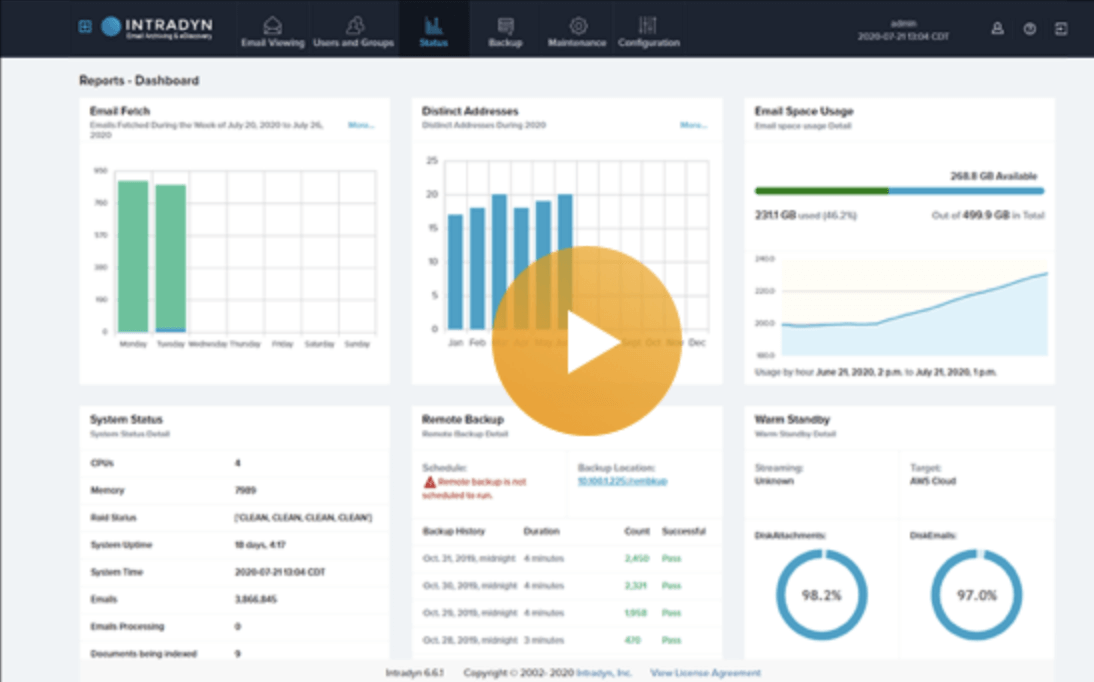
Documenting these activities is equally vital. Dashboards that tie alerts back to the SSP and previous risk assessments allow security officers to demonstrate remediation progress and justify resource requests during quarterly Chief Information Officer and Inspector General briefings.
Combined, system categorization and continuous monitoring turn FISMA from a periodic audit exercise into an operational discipline that reduces security incidents and data breaches.
Implementing Effective Email Archiving Solutions
 While FISMA compliance emphasizes the security of systems, its practical mandate is the protection of the information inside those systems. In the context of FOIA requests, Inspector General audits, and day-to-day records management, that means agencies and organizations need to guarantee that email communications — often the largest and riskiest pool of unstructured data — are stored, accessed, and produced in a manner that is both secure and defensible.
Modern archiving solutions are no longer “nice to have,” they are critical infrastructure for maintaining compliance efforts. To align with FISMA compliance requirements, platforms should deliver at a minimum, five core security measures:
- Granular, role-based access controls. This ensures only authorized personnel can view or export sensitive information.
- Encryption at rest and in transit. Essential to protect data against interception and breaches.
- Multi-factor authentication. This hardens user logins against credential theft.
- 24/7 monitoring and alerting. Such practices detect anomalies before they escalate into reportable security incidents.
- Integrity preservation mechanisms. Including hash verification and tamper-proof storage, this demonstrates confidentiality and data authenticity.
Extending These Safeguards
Intradyn’s email archiving platform goes beyond these baseline expectations and directly supports FISMA compliance needs through:
- Customizable email archiving retention policies that map to FISMA impact levels, ensuring that low, moderate, and high-risk federal information is managed according to regulatory expectations.
- Immutable storage architecture that prevents tampering and preserves records in their original form, as this is critical for audits and homeland security mandates.
- Advanced search functionality, including tolerance for misspellings and Boolean queries, so compliance teams can retrieve relevant emails in seconds, even under tight FOIA or litigation deadlines.
- Built-in audit trails that automatically log every access, export, and change, enabling compliance officers to demonstrate a clear chain of custody in line with FISMA and required guidelines.
- One-click legal holds to preserve records for litigation or Inspector General reviews without relying on external tools or manual procedures.
These capabilities are more than convenient — they directly reduce compliance efforts and risk. By eliminating the need for multiple auxiliary systems and cutting preparation time for discovery or audits, federal agencies and organizations can focus resources on mission-critical operations while maintaining full FISMA compliance.
Empowering Your Organization for FISMA Success
FISMA regulation is more than a reporting requirement. It is a framework for continuous accountability, risk management, and organizational operations resilience. Agencies and organizations that integrate disciplined RMF practices with proactive email archiving gain a distinct advantage: audit-ready records, streamlined FOIA responses, and demonstrable protection of sensitive information.
By leveraging immutable storage, granular access controls, and automated legal holds, organizations can transform compliance from a periodic checkpoint into an ongoing, transparent process.
Solutions like Intradyn’s email archiving platform make it easier to enforce these safeguards, maintain chain-of-custody, and ensure that every message is secured in alignment with FISMA compliance requirements.
Ready to simplify FISMA compliance and safeguard every message in your environment? Contact Intradyn for a free demo on secure email archiving solutions.